
Object Record
Images


Metadata
Catalog Number |
1993.01.05 |
Object Type |
Timpanum |
Title |
Timbalettes |
Description |
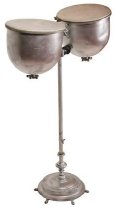
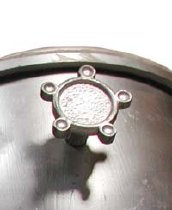
Silver crank-tuned 10" metal drums (2) on silver stand. Stand is ornately cast round base with six evenly-spaced small feet holding up central post. Around post, near base is a circle of 1/8" leather, 1/2" wide. Paint on base flaking and peeling to show base coat underneath. At top of post is an attachment with two 2" black rubber feet that hold timbales away from stand. Each drum has a 10" head and is 9.5" deep. Each is silver, has two cranks, one on side and one underneath. Each has "TIMBALETTE, BLE SDGD, |
Dimensions |
H-38 Dia-10.5 inches |
Date |
c. 1920 |
Additional Research |
Timbalettes are a pair of small, mounted, tunable drums modeled after larger timpani or kettledrums. Manufactured in France by the ASBA company, it is apparent that the name of the instrument originates from the diminutive form of "timbales," the French word for timpani. Although the date of manufacture is unknown, it seems likely that this instrument was manufactured in the early 20th Century due to the casting of the knobs and the decorative design of the stand. Identical in size, each drum has a 10 1/2-inch head mounted on a metal bowl that is nine inches deep. One drum has a plastic head and the other has a head made of a thin animal membrane; both overlap the drums' edges and are clamped to the bowls by metal retaining rings. The tension on the head is adjusted by means of an interior tuning mechanism that pushes against the inside of the head. This mechanism, which has a circular construction with six arms, is manipulated by two knobs. One knob is connected to the side of the bowl and the other is connected to this mechanism at the bottom. When mounted on the stand, the drums rise to a height of 38 1/2 inches. The base of the decorative, cast-iron stand is 10 1/2 inches in width. Percussive Notes, December 2005. Timbalettes France These paired French drums with 10" heads are tuned by turning the knobs on the side and bottom of each instrument. The knobs control a network of rods on the inside of the drum, called a "spider" mechanism. This type of internal tuning, designed to tighten or loosen the drumhead, is still used on some modern timpani. Because they are small and easily tuned, it is likely that these timbalettes were used in opera orchestra at the end of the 19th century. PAS Museum Exhibit Label |
Credit line |
Gift of Carroll Bratman |