
Object Record
Images
Metadata
Catalog Number |
2004.03.01 |
Object Type |
Instrument, Percussion |
Creator |
J. C. Deagan, Inc. |
Title |
Model 7115 Steel Marimbaphone |
Description |
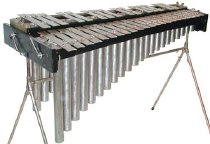
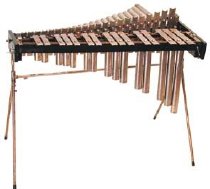
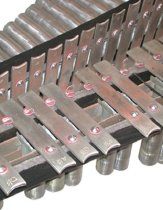
Deagan Steel Marimbaphone Model 7115. 3 octaves chromatic F21 to F57 (low pitch). Each set of bars can be rotated vertically for bowing, and bars are concave on one end to facilitate bowing. Metal resonators and metal pipe stand. Edge of frame reads: "J.C. DEAGAN CHICAGO PATENTED" Low F bar reads: "MAR 6-1900 / MAY 21-1901 / JULY 28-1903 / DEC. 15-1903" Low F# bar reads: "PAT. NOV. 8-1904 / PAT. APR. 24-1906 / JUNE 9-1908 / OTHER PATENTS PENDING" Low A bar reads: "L / J.C. DEAGAN / CHICAGO / PATENTED" |
Dimensions |
H-32 W-20.75 L-42.5 inches |
People |
J. C. Deagan, Inc. |
Date |
c. 1910 |
Additional Research |
Manufactured during the first few decades of the 20th century, Deagan's marimbaphones were designed as novelty instruments for use on the stage or in the home. Deagan Catalog G boasted that the instrument "is a most valuable addition to any orchestra in which it will replace the Italian Harp, "would" blend perfectly with the voice, "and was "very adaptable for home use." It further described the instrument's tone and use by saying that "as the instrument is very simple to play and the tone is of absolutely the very finest quality, being similar to that of Musical Glasses, it makes an ideal instrument for a Music Room." The marimbaphone's bars were manufactured of high-quality steel, which provided excellent sustaining characteristics and projection. The instrument has several unique features, the most important one being the ability to independently rotate each set of bars to a vertical position, allowing the performer to bow the bars on the ends. Additionally, each bar was manufactured with a curved end to assist with the bowing technique. When the bars are in the horizontal position, the performer has the option of positioning the accidentals at the same level as the naturals, or in the more familiar raised and overlapping position seen on most mallet instruments today. The instrument can be struck with mallets as well as bowed when in the horizontal position, and can be performed on by more than one player using both techniques if so desired. Catalog G offered marimbaphones in ranges of approximately 2, 2 1/2, 3, 3 1/2, 4, and 4 1/2 octaves, with a variety of starting pitches. The instrument was also offered in "high" and "low" pitch tuning, as it was manufactured before the adoption of A=440 tuning by the American Federation of Musicians in May 1917. This model, 7015, is tuned in "low" pitch with a range of 3 octaves (F3 to F6). The bars are from 1 3/16 inches to 1 5/8 inches in width, range in length from 6 to 12 inches, and are graduated in thickness from 6mm to 2 mm from the shortest to the longest bar. It stands 32 inches in height, is 42 1/2 inches in length, and 20 3/4 inches at the widest end. Percussive Notes, June 2004, edited 2020. Steel Marimbaphone, Model 7015 c.1915 The Deagan steel marimbaphone was designed to permit the rows of bars and their resonators to be rotated independently. In the horizontal position, the bars were typically struck with mallets. Moved into a vertical orientation, the bars could be played with a rosined violin or bass bow. Note the curved bar ends, a feature that helps the performer keep the bow in contact with the vibrating bar. In Deagan's "Piano Keyboard Reference," the range of this instrument is F21 to F57. In this system, middle-C was C40 (now C4). Manufacture during the first few decades of the 20th century, the marimbaphone produced by the Deagan company were designed as novelty instruments for use on the stage or in the home. PAS Museum Exhibit Label |
Credit line |
Gift of Charles W. Trexler and Carl D. Sarine |