
Object Record
Images
Metadata
Catalog Number |
1995.02.17 |
Object Type |
Instrument, Percussion |
Title |
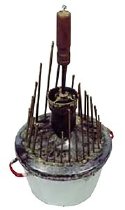
Waterphone |
Description |
Waterphone, made from a white cooking pot with red handles welded to a ford hub cap, with graduated nails and a central phone with handle. 10" diameter x 22" OH. |
Dimensions |
H-22 Dia-10 inches |
People |
Manne, Shelly |
Date |
1971 |
Additional Research |
Invented and patented by multi-media artist, musician and kinetic sculptor Richard Waters, the Waterphone is a unique instrument that blends the principals of a Tibetan water drum, a kalimba and a 16th-century nail violin. Waters developed the Waterphone in 1967 and has also applied the use of water to other percussion instruments, including gongs, quicas, drums and chimes. Initially used for special-effects sounds, the instrument also had an unexpected function, as related by Waters in a 1984 Percussive Notes article: "Shortly after I invented the waterphone, Jim Nollman, a drummer working for Greenpeace, took a Bass Waterphone to Hawaii where he called a pod of whales which circled him as he played and was kept afloat by the waterphone. Since that time, several whale conservation groups both here and abroad have utilized waterphones for interspecies communication with whales and other cetaceans." The Waterphone consists of a bowl that holds the water, a resonator tube or handle, and metal rods of varying length and size. The rods are tuned to a combination of microtonal and diatonic pitch relationships. The rods are struck by mallets, plucked by fingers or bowed. As the player strikes a rod and turns the instrument, the water in the bowl moves, shifting the shape of the resonating chamber, creating pitch changes and bends, glissandi and water echoes. Waterphones have been used in recordings by Miles Davis and George Marsh, and on film and television soundtracks, including Poltergeist, Star Trek: The Movie and, The Man Who Skied Down Everest. Percussive Notes, October 1997. This prototype of Richard Waters' waterphone is made from a cooking pot and a Ford hubcap. To play it, you fill the base with water, and strike or bow the metal rods. Moving the water inside changes the sound of the instrument. The unique sounds it produces have been used to call whales, and you also may have heard it in the 1982 film "Poltergeist." And the Kitchen Sink, 2016. The "sonic creation" from Water's studio with the trapezoidal bowl was donated by Emil Richards. The bowl of the free-standing Waterphone is signed by the maker, Richard Waters, Fairfax CA, 1971. It was donated by Florence "Flip" Manne, along with the improvised model that uses a cooking pot for the water chamber and a Ford hubcap as the chamber ld. Richard Waters continues to create new sound devices and musical instruments from his studio in Ocean Springs, Mississippi. PAS Museum Exhibit Label Waterphones United States The Waterphone is a unique instrument that blends the structural and acoustic principals of a Tibetan water drum, the African kalimba, and a sixteenth-century nail violin. Invented and patented by Ruchard A. Waters in 1967, the Waterphone consists of a bowl, a resonator tube or handle, and metal rods of varying length and size. The rods are tuned to a combination of microtonal and diatonic pitch relationships and may be struck, plucked, or bowed. The chamber of the Waterphone is designed to hold a small amount of water. As the instrument is rotated, the water is set in motion. This action varies the shape of the resonating chamber, creating pitch changes and bends, glissandi and water echoes. In an article of Percussive Notes (October 1984), Waters recalls that "Jim Nollman, a drummer working for Greenpeace, took a Bass Waterphone to Hawaii where he called a pod of whales which circled him as he played and was kept afloat by the waterphone. Since that time, several whale conservation groups both here and abroad have utilized waterphones for interspecies communicaion with whales and other cetacean." Waters has also applied the use of water to other percussion instruments, including gongs, quicas, drums and chimes. His instruments have appeared in recordings by Miles Davis and George Marsh and can be heard on film and television soundtracks, including Poltergeist, Star Trek: The Movie and The Man Who Skied Down Everest. PAS Museum Exhibit Label |
Credit line |
Gift of Flip Manne (Mrs. Shelly Manne) |