
Object Record
Images
Metadata
Catalog Number |
2002.10.03 |
Object Type |
Vibraphone |
Creator |
Musser, Clair Omar |
Title |
Vibraphone |
Description |
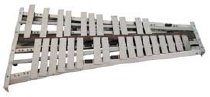
Experimental vibraphone, without stand, in which bars are electrically amplified. Three octaves, F to F. Central damper, with amplification bars located below the natural and accidental keys. Vibraphone frame is 24" (at the lower end) x 9.75" wide (at the upper end) x 44" long x 2.25" deep. Missing bars are low F, G, G# (first octave); G, C (second octave); A#, C#, D#, F (third octave). |
Dimensions |
H-3 W-24 L-45 inches |
People |
Musser, Clair Omar |
Date |
c. 1960 |
Additional Research |
Clair Musser's interest in amplified vibraphone design dates from the late 1920s, with his work on the Marimba Celeste designed for J.C. Deagan. Musser's interest in this experimental field throughout his most creative years is confirmed in a letter Don Moors wrote in November 1973, recalling their meeting two months earlier when they discussed "different possible methods of amplifying vibes." This letter points to the period when Musser was apparently at work on the two prototype amplified vibraphones featured here. Designed solely as electronically amplified instruments, Musser's prototype Amplified Vibraphones incorporate a passive pickup assembly, which comprises two straight bars, one mounted beneath the natural keys and one mounted below the accidental keys. This pickup is a magnet with coiled wires running underneath, similar to the type of pickup that first appeared in 1950 and is still used to amplify electric guitars today. Several structural features in the silver-bar instrument (2002-10-03) should be considered design improvements over comparable elements in the smaller gold-bar instrument (2002-10-04). Among the improvements found on the larger instrument is the use of soldering on the electronic pickup bars, a more advantageous layout of the electrical cable, wider bars for ease of playing, and a more sophisticated dampener mechanism. Also, the rails are designed to better align with the inside and outside shape of the bars, unlike those on the gold-bar instrument whose pegs are aligned exactly the same for both the natural and the accidental bars. The full range of bars originally created for these instruments is no longer complete. Percussive Notes, December 2003. Prototype Amplified Vibraphone Designed and Constructed by Clair Omar Musser c. 1970s It appears that Musser had almost perfected his concept by the time this 3-octave (F to F) vibraphone was built. In contrast with the amplification system designed for the more compact instrument, the pickup bars of this vibraphone are soldered together. The layout of the cable is flawless, the keyboard bars are much wider, and the dampener system is structurally more sophisticated. The inside rails of this instrument are perfectly straight, and the outside rails follow the naturally diminishing lengths of the chromatically tuned bars. Both the playing surface of each bar and the finished size of the instrument itself allow the performer to move from a traditional accoustic vibraphone to Musser's amplified model with relative ease. The dampener machanism is quickly connected to a pedal, and it bears a close resemblance to the present-day system. Except that a number of the original bars have been lost, the design of this instrument brings it close to performance-level quality. Donated by Emil Richards PAS Museum Exhibit Label |
Credit line |
Gift of Emil Richards |