
Object Record
Images
Metadata
Catalog Number |
1993.01.02 |
Object Type |
Marimba |
Creator |
Leedy Manufacturing Company |
Title |
Octarimba |
Description |
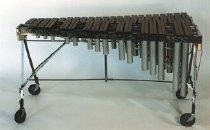
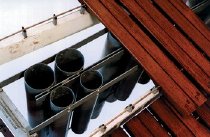
Leedy Octarimba. Three octave C-C. Brazilian rosewood bars with octave bars side by side on velvet rests, held down by brown cord, separated by felt circular spacers (some missing). Bars are marked with note: Low C-octave bar also has "5602". Steel resonators rest on wooden white-painted frame with metal end caps. Each set of resonators is doubled to account for octave bars. On left ends stamped "Raise resonators in warm temperature, lower resonators in cool temperature." Steel legs and supports, 1" wide, support rest of frame. Four rubber casters at feet. Gray Pearlized "plastisine" finish on front and back of wooden frame. Frame can fold in center. |
Dimensions |
H-34.5 W-31 L-61.5 inches |
People |
Leedy Manufacturing Company |
Date |
c. 1934 |
Additional Research |
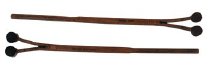
The Octarimba was designed by the Leedy Drum Company to combine the "full resonant speaking voice of the marimba" with the "higher and more brilliant timbre of the xylophone." Each playing note of the Octarimba consists of two adjacent rosewood bars tuned one octave apart, each with an appropriately tuned resonator. The bars are played simultaneously with double- headed forked mallets. The result is a four- octave sounding range from an instrument with a three-octave playing range. An advertisement in the August 1934 Leedy Drum Topics states, "The Octarimba is a legitimate musical instrument in every way and should not be considered a novelty." A 1935 ad extols, "Never before has there been a wood-bar instrument to equal the Octarimba's eloquence, sympathetic response or latitude of expression!" The instrument sold for $240 in a choice of three finishes with five sets of the double-headed mallets, which have proved to be more rare than the instrument itself. Leedy made only fifty Octarimbas during the 1930s: 25 of the instruments were tuned from F to F, and 25 were tuned from C to C. To increase sales, later instruments were sold with a set of both Octarimba bars and regular marimba bars. Although the instrument never caught on, Joe Green released a 1938 recording for the Decca label playing "My Toreador" and "Lady of Madrid" as Octarimba solos with organ accompaniment. Percussive Notes, April 1997. |
Credit line |
Gift of Carroll Bratman |